
Single amino acid scanning of the CD20 epitope, 79 variants on one chip, screened against rituximab and ocrelizumab. Agu et al., bioRxiv (2026).
Our fourth SPOC paper was posted on bioRxiv (Agu et al., 2026, preprint) and applies the platform to single-amino-acid-resolution epitope mapping. The paper reports a 79-variant partial deep mutational scan of the CD20 extracellular domain (ECD) screened against the FDA-approved anti-CD20 monoclonal antibodies rituximab and ocrelizumab, with apparent kinetic affinity (KD’) measured for every variant in a single SPR run on one biosensor chip.
Background
Epitope mapping is central to antibody drug development, affinity optimization, and anticipating therapeutic resistance. X-ray crystallography is the gold standard for resolving antibody-antigen interactions at atomic detail, but it is low-throughput, requires large quantities of purified material, and not all complexes crystallize. Cryo-EM and mass spectrometry have similar throughput and equipment constraints. Mutagenesis-based methods (peptide arrays, domain exchange, alanine scanning) are accessible but each carries trade-offs: peptide arrays do not present folded protein, domain exchange requires orthogonal confirmation, and alanine substitutions alone cannot distinguish loss-of-binding from local structural perturbation.
The cost of producing large deep mutationally scanned (DMS) target libraries by traditional recombinant expression and purification has kept residue-level epitope mapping out of routine antibody discovery campaigns. The SPOC platform reported in Agu et al. (Communications Biology, 2025) produces up to 2,304 full-length proteins on a single SPR biosensor from a DNA library and outputs real-time kinetic data per spot. This paper applies that workflow to a target DMS library and pairs it with two clinical anti-CD20 antibodies as the readout.
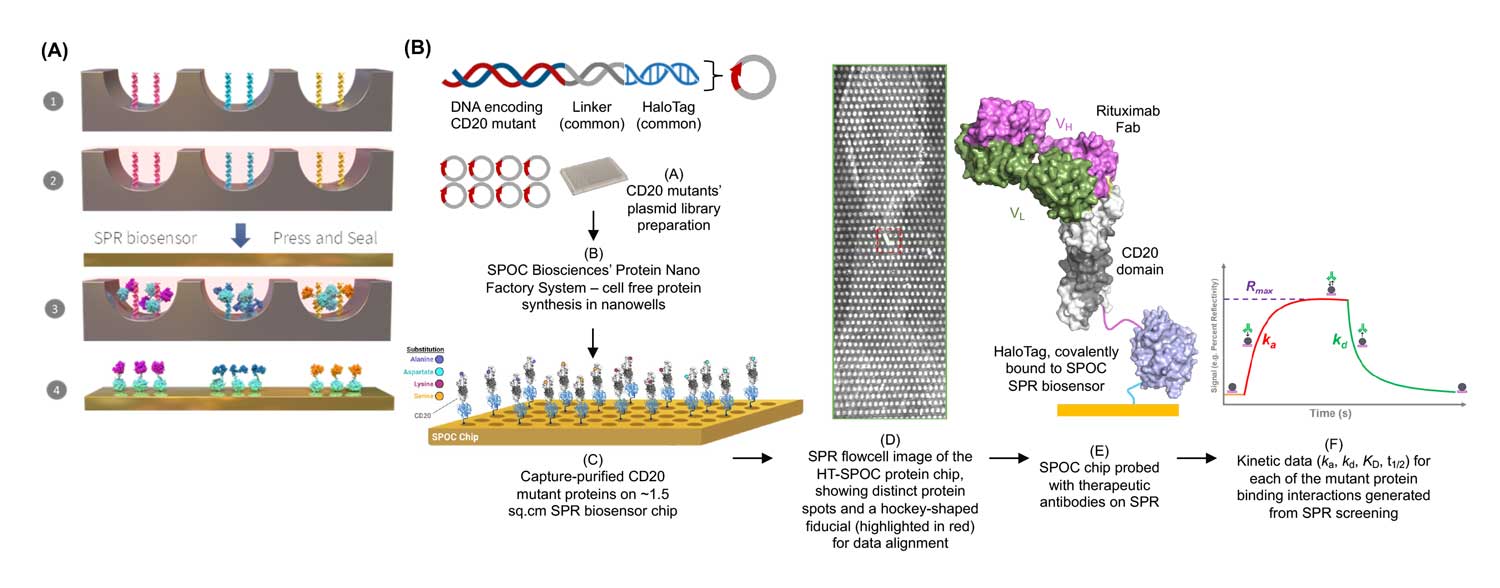
(A) The four-step SPOC nanowell-to-biosensor workflow: plasmid printed into each nanowell, cell-free lysate added, HaloTag-functionalized capture slide press-sealed on top, slides incubated. (B-F) Graphical abstract of the DMS screening setup used in this study.
CD20 mutant library design
The CD20 sequence between residues 41 and 218 was expressed as an N-terminal HaloTag fusion, with residues 158 to 183 (HTPYINIYNCEPANPSEKNSPSTQYC) targeted for partial DMS. This region encompasses the rituximab epitope (EPANPSEK, residues 168–175) and the ocrelizumab epitope (YNCEPANPSEKNSPST, residues 165–180). Each residue in the targeted window was substituted to alanine (nonpolar), aspartate (acidic), lysine (basic), and serine (neutral polar), covering four broad side-chain chemistries.
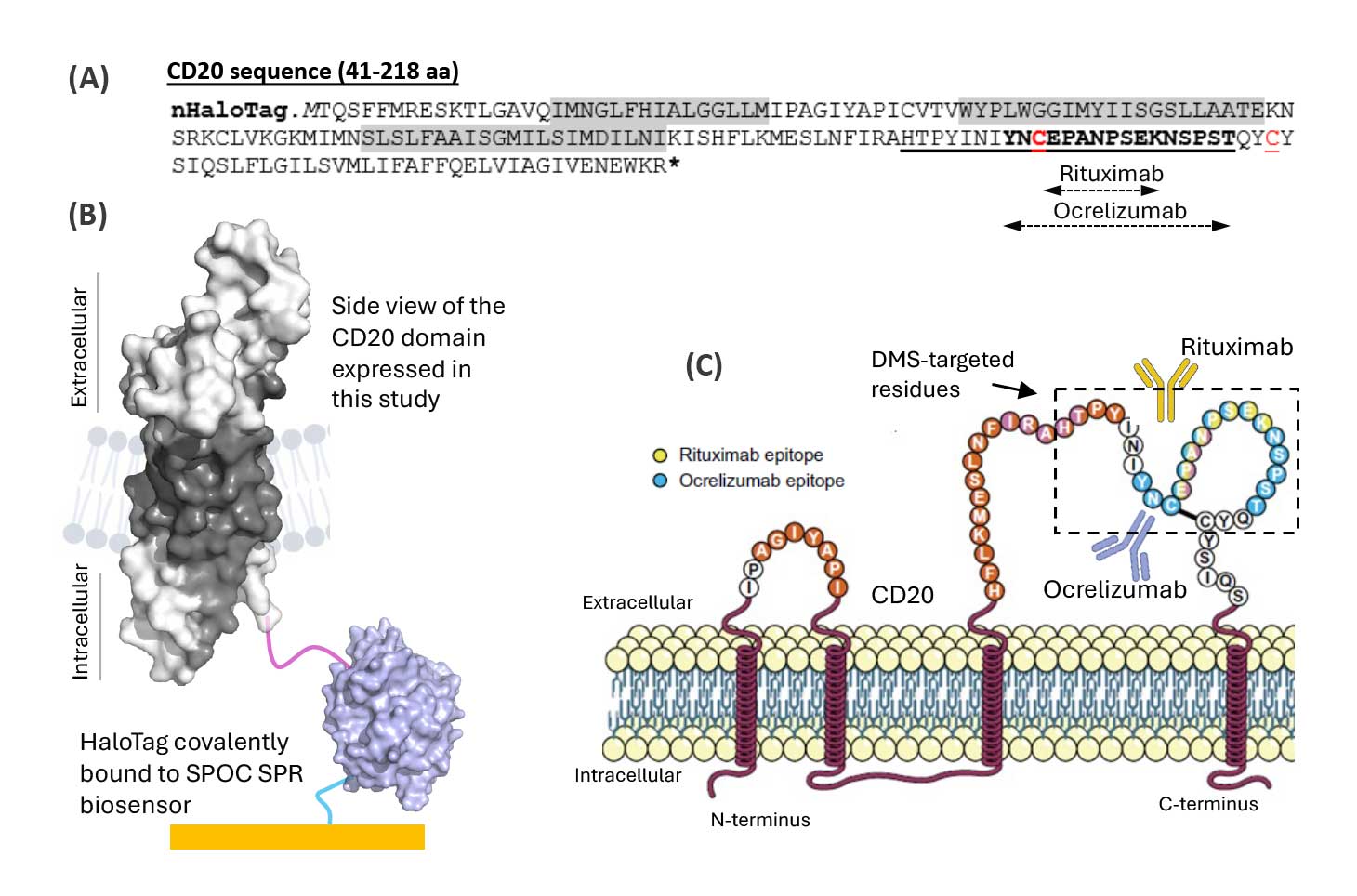
(A) Sequence map of the partial CD20 construct expressed in this study (residues 41–218). Membrane-spanning residues are shaded gray; non-membrane residues are unshaded; cysteine residues responsible for disulfide bond formation (C167, C183) are highlighted in red. Only the underlined residues were targeted for partial mutational scanning. (B) PyMol structure of the partial CD20 plus N-terminal HaloTag fusion as immobilized on the SPOC biosensor, adapted from PDB 6VJA. The first five and last nine residues of the partial CD20 sequence are not displayed. The lipid bilayer is shown for orientation only; CD20 was not displayed with a lipid bilayer on the SPOC chip. (C) Orientation of CD20 on the lipid bilayer with the rituximab and ocrelizumab binding epitopes color-coded (adapted from Delgado et al.).
In addition to single substitutions, the library included two multi-alanine variants spanning the rituximab epitope (E168A:P169A:N171A and P172A:S173A:E174A:K175A) and three cysteine substitutions (C167A, C183A, C167A:C183A) targeting the disulfide pair that stabilizes the extracellular loop. Total library size: 79 variants, all printed in duplicate on a single SPOC chip alongside controls (Fos, Jun, FGA, Src, EGFR, HER2, KRAS, VEGFR1, BRD4, MLLT1, empty HaloTag, and a p53 cross-diffusion control).
Library expression and capture validation
Capture validation was run on the SPOC SPR biosensor with mouse anti-HaloTag (133 nM) and anti-HaloTag VHH (220 nM) injections, plus anti-p53 (16 nM) to confirm zero spot-to-spot crosstalk. Capture RU values for the wildtype and 77 of 79 mutants ranged from 156 (N176D) to 228 (E168S), with WT at 196 RU. Two variants, T159K (10 RU) and I162S (76 RU), expressed poorly and were excluded from kinetic analysis. Successful expression rate across the library: 97.5%. Neither excluded position falls within the core rituximab or ocrelizumab epitope, so their exclusion does not affect the primary conclusions.
Fluorescent confirmation on the paired glass capture slide showed selective rituximab and ocrelizumab binding only at CD20 spots and at the human IgG scFv positive control. Anti-HaloTag re-probing of the same slide showed expression and capture across the rest of the library, with T159K and I162S again the two negatives, consistent with the SPR capture heatmap.
Differential binding response of rituximab and ocrelizumab
Rituximab was injected at 0.8, 2.5, 7.5, 22.4, and 67.1 nM. Ocrelizumab was injected at 0.8, 2.5, 7.5, 22.4, 67.3, and 101 nM. The SPR run used a 1-minute baseline, 30-minute association, and 60-minute dissociation, on a Carterra LSAXT.
At the highest analyte concentrations, RU values across epitope mutants ranged from 0 to 33 for rituximab (vs. WT at 44) and 0 to 27 for ocrelizumab (vs. WT at 22). Most epitope mutations produced zero binding response. Both multi-alanine epitope mutants (E168A:P169A:N171A and P172A:S173A:E174A:K175A) eliminated binding to both antibodies. The single and double cysteine mutants (C167A, C183A, C167A:C183A) produced zero or substantially reduced binding response relative to wildtype.
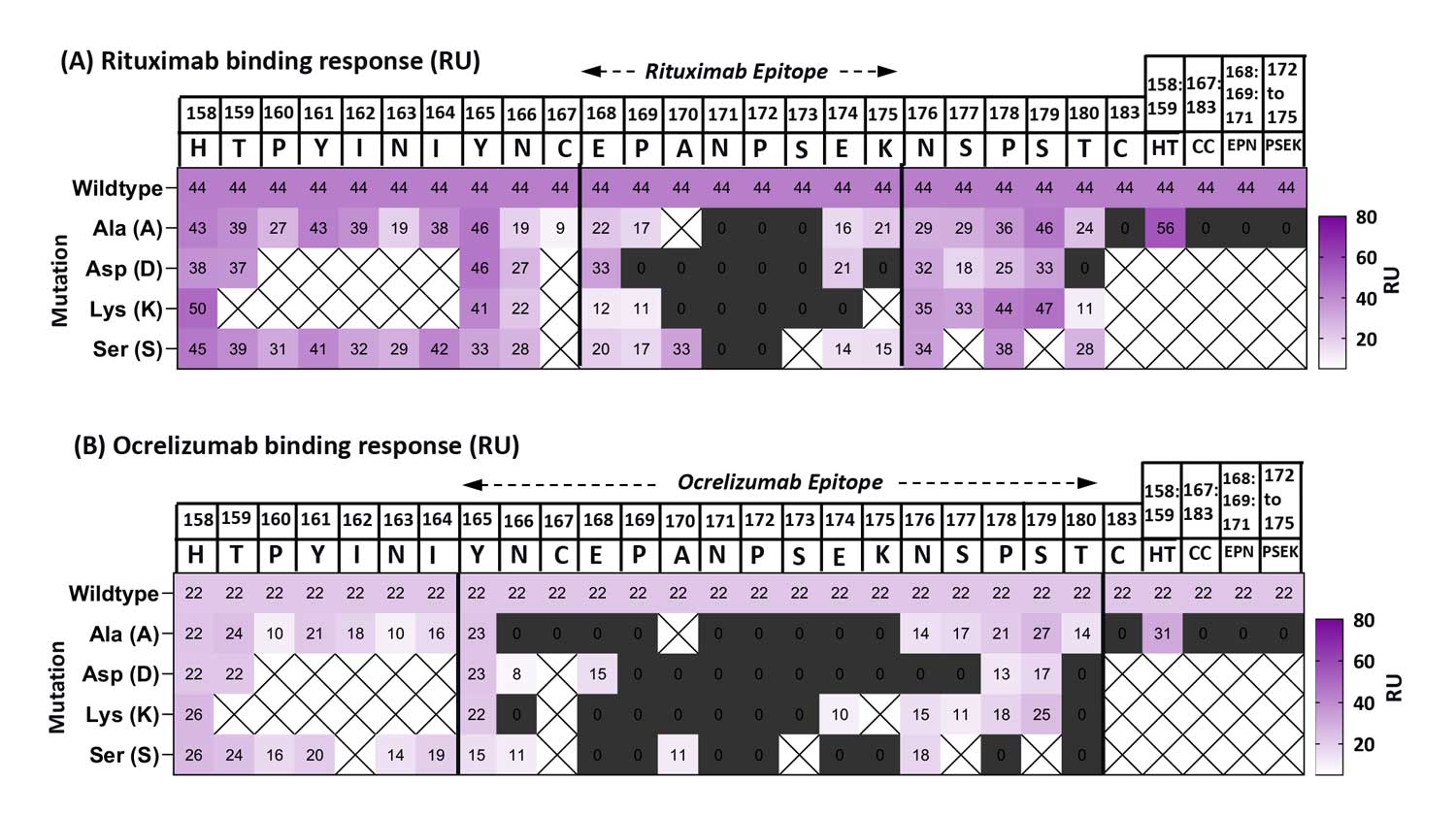
Heatmaps of mean binding response (RU) of CD20 mutants against (A) rituximab and (B) ocrelizumab. Columns label the native CD20 residue position; rows label the substitution chemistry. Crossed cells indicate the wildtype identity (no substitution). Full sensorgrams appear in Figures S4 and S5.
Critical epitope residues
KD’ values were extracted by 1:1 Langmuir global fit. Because the analytes are bivalent IgG1, KD’ is reported as apparent affinity rather than monovalent KD. A >25% increase in KD’ relative to wildtype was scored as significant loss; a >25% decrease was scored as significant gain.
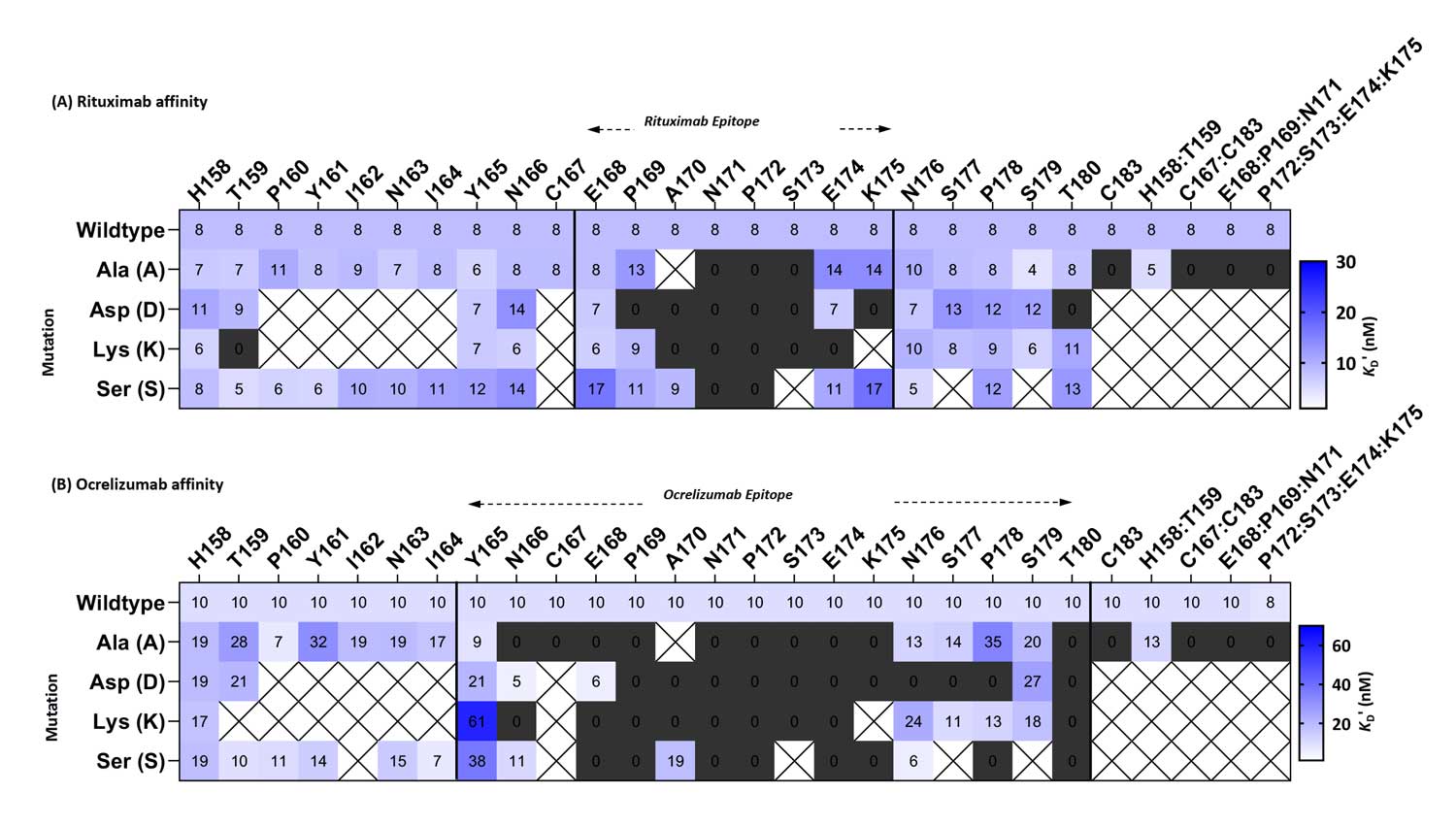
Heatmaps of mean apparent binding affinities (KD') of CD20 mutants to (A) rituximab and (B) ocrelizumab, with the literature-reported epitope clusters indicated. Columns label the native CD20 residue position; rows label the substitution chemistry. Crossed cells indicate the wildtype identity. Gray cells indicate mutations that resulted in complete loss of binding.
For rituximab, three residues showed complete loss of binding regardless of substitution chemistry:
N171 — alanine, aspartate, lysine, and serine all ablated binding.
P172 — alanine, aspartate, lysine, and serine all ablated binding.
S173 — alanine, aspartate, and lysine all ablated binding.
When chemically diverse substitutions converge on the same loss-of-binding outcome, direct epitope disruption is the most parsimonious interpretation. The convergence at these three positions is the cleanest evidence in the dataset for direct rituximab contact. Multi-substitution evidence supports the same conclusion: P169A and E168A alone did not eliminate rituximab binding, but the triple mutant E168A:P169A:N171A did, consistent with N171 driving the effect. Similarly, single E174A and K175A retained binding, but the quadruple mutant P172A:S173A:E174A:K175A eliminated it, consistent with P172 and S173 as the primary drivers.
For ocrelizumab, eight residues (E168, P169, N171, P172, S173, E174, K175, T180) lost binding under at least three of the four substitution classes, identifying a broader critical contact set than rituximab.
A small number of epitope substitutions enhanced ocrelizumab binding rather than disrupting it: N166D, E168D, and N176S all produced >25% reduction in KD’. The rituximab epitope did not show this pattern, with the exception of E168K. The EPANPSEK cluster appears more conserved for productive engagement with rituximab than the YNCEPANPSEKNSPST cluster is for ocrelizumab.
Disulfide bond requirement
The C167–C183 disulfide stabilizes the CD20 extracellular loop. Single mutations C167A and C183A and the double mutant C167A:C183A all eliminated rituximab binding, even though C167 and C183 sit outside the EPANPSEK cluster. The same mutations eliminated ocrelizumab binding. C167 falls within the ocrelizumab YNCEPANPSEKNSPST cluster, but C183 does not, and C183A still ablated ocrelizumab binding. The disulfide is required for both antibodies to engage their epitope, independent of whether the cysteine itself sits inside the linear epitope window.
This result agrees with prior reports of CD20 mutations driving anti-CD20 therapy resistance in CD20-knockout cell lines: a recent study reported missense C167G and K175E mutations and a P160 frameshift among the lesions associated with loss of rituximab binding. The SPOC data here recapitulate the C167, K175, and P160 sensitivity in a controlled, residue-resolved format.
Non-epitope residues that contribute to binding
Substitutions outside the EPANPSEK and YNCEPANPSEKNSPST clusters typically did not eliminate antibody binding, but several modulated affinity by more than 25%.
For rituximab, eight non-epitope substitutions enhanced affinity: H158K, T159S, P160S, Y161S, Y165A, N176S, S179A, S179K, and T180K. Most non-epitope substitutions had no measurable effect. T180D was the one non-epitope mutant outside the cysteine pair that ablated binding entirely.
For ocrelizumab, P160A and I164S enhanced affinity. H158A, H158D, H158S, T159A, T159D, Y161A, Y161S, I162A, N163A, N163S, and I164A produced partial loss of binding (>25% KD’ increase).
The set of non-epitope residues that affect affinity in either direction maps the surrounding paratope contact zone for each antibody. These residues are candidates for paratope-directed affinity maturation: regions on the antibody CDRs that interface with these CD20 positions are the parts most likely to yield productive substitutions in a paired DMS paratope scan.
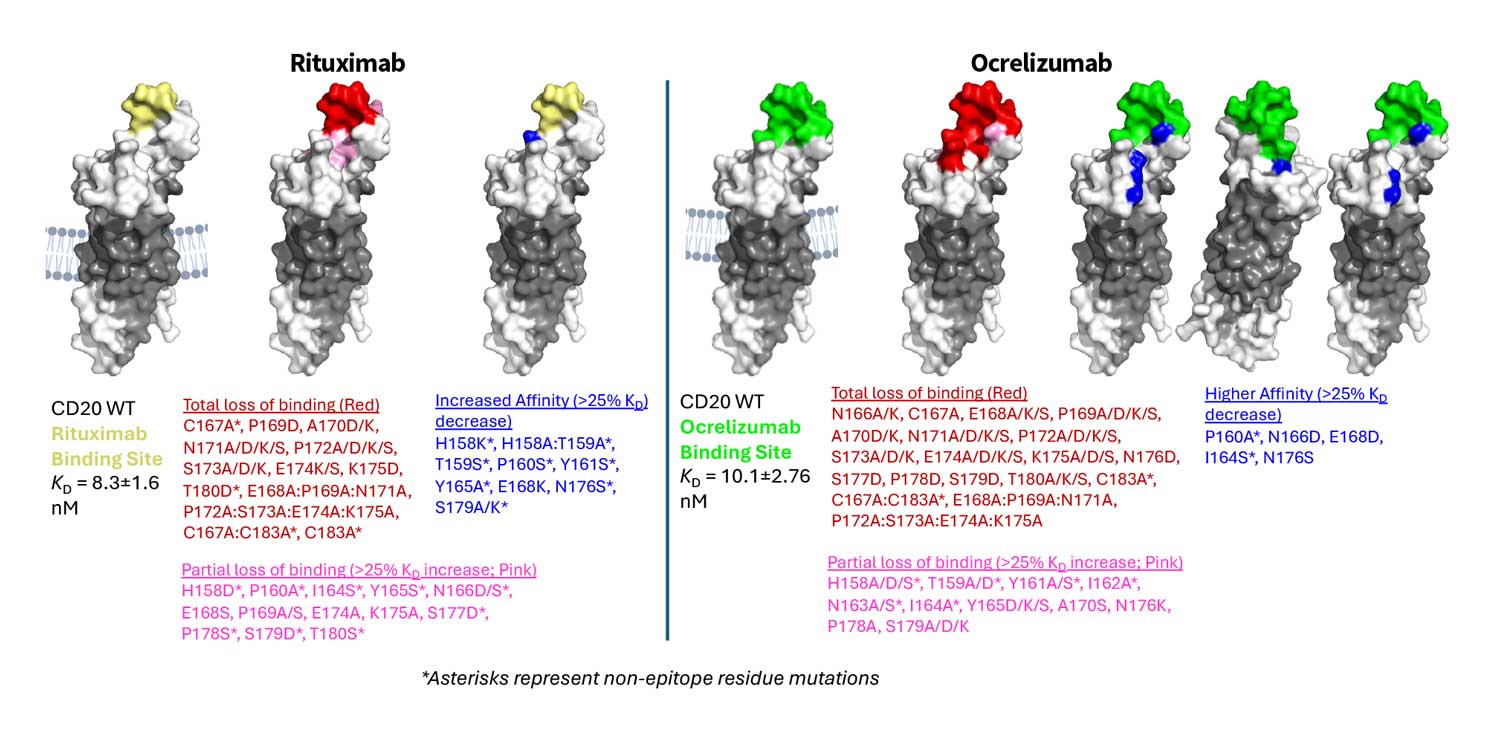
PyMol visualization of CD20 with mutated residues color-coded by their effect on each antibody. Rituximab and ocrelizumab epitope clusters are shown in yellow and green, respectively. Residues whose mutations led to complete loss of binding are red; residues whose mutations led to partial loss of affinity are pink; residues whose mutations improved affinity are blue.
Read the preprint: https://www.biorxiv.org/content/10.64898/2026.04.30.722015
