
Part 1 of a two-part series on where developability data enters antibody discovery, and what that timing costs.

An antibody only reaches the clinic if it expresses well, stays folded, resists aggregation, and survives the chemical and physical stress of manufacturing and storage. These developability properties decide which molecules make it. Yet most discovery campaigns select on binding data alone, because the stability assays that would test those properties have been either impractical or impossible to run at scale. Those assays enter the pipeline during or after formulation development, too late to course-correct if a problem appears.
In this two-part series, we look at what the current developability and manufacturing stress tests measure, when they enter the pipeline and why, and how we can do better.
How the Pipeline Narrows the Candidate List
A campaign starts with good diversity, drawing on molecules from animal immunization or a naïve library. Primary screening returns hundreds to thousands of binding hits, and on/off confirmation with preliminary ELISA data drives the first cut, taking the set from hundreds down to tens of variants.
That first cut is also the largest, and because the stability panel has not entered the pipeline yet, it happens almost entirely on binding signal. The variants dropped at this point are ranked on how they bound and nothing more, which means a hundred or so molecules can leave the funnel before a single stability measurement exists for any of them. Everything downstream works from the survivors of that first decision.
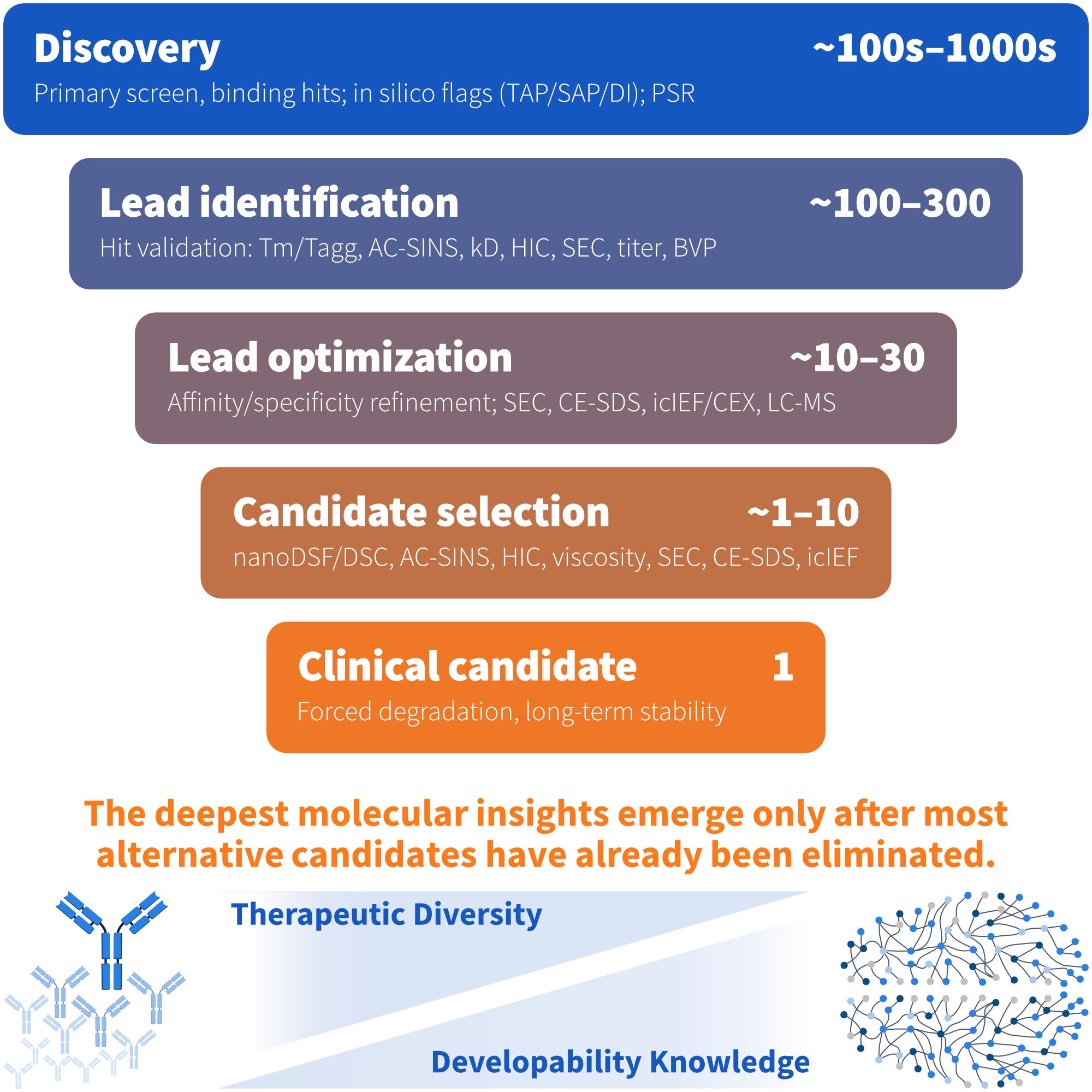
Figure 1: We place each developability assay at the stage where it usually enters, against the molecules still in play. As we narrow the funnel, we trade therapeutic diversity for developability knowledge: we learn the most about a molecule only after we have dropped the candidates we could have compared it against. By the time we run forced degradation and long-term stability, we have one to five molecules left.
What Early Discovery Measures
Not much stability work happens at the discovery stage. The hit list is still large, material per clone is limited, and the pressure is to move to the next round, so any stability testing that does happen tends to be a short biophysical panel run on a subset of the hits. The endpoints that fit those constraints are the ones that read out quickly and need little protein.
Thermal Stability
Of the endpoints in that early panel, thermal unfolding is the most common. nanoDSF measures intrinsic tryptophan and tyrosine fluorescence as temperature rises and reports the melting temperature (Tm) at the unfolding transition, while differential scanning calorimetry (DSC) measures the same transition by heat capacity and remains the reference method at lower throughput. A low Tm flags a molecule likely to unfold under thermal or mechanical stress downstream, which is why many panels pair it with an aggregation onset temperature (Tagg) read from light scattering on the same heating ramp.
Colloidal Stability and Hydrophobicity
Closely related is colloidal self-interaction, which predicts how a molecule will aggregate and how viscous it will become at the high concentrations used for subcutaneous dosing. The diffusion interaction parameter (kD) comes from dynamic light scattering across a dilution series, AC-SINS detects self-association at concentrations far below what a direct assay needs, and the second virial coefficient (B22 or A2) from static light scattering reports the same tendency, though it needs purified material at higher concentration, which is why it tends to come into the picture in later stages. Surface hydrophobicity is a separate driver of the same aggregation and self-association, and is ranked by hydrophobic interaction chromatography (HIC) or SMAC, since exposed hydrophobic patches make a molecule both stickier to itself and more prone to nonspecific binding.
Polyreactivity
Polyreactivity is the tendency to bind unrelated moieties, and it contributes to faster clearance and off-target effects. The poly-specificity reagent (PSR) assay scores binding to a membrane-protein mixture by flow cytometry, the baculovirus particle (BVP) ELISA scores binding to viral particle preparations, and panels against dsDNA, insulin, and similar antigens add orthogonal reads. Polyreactivity is unusual in its staging compared to other developability endpoints, since some of these assays run as early as primary screening, applied as negative selection against the reagents tested. This is especially true of naïve library screens, which often build in one or more negative selection steps. The reach is still narrow, though, since it is impractical to screen against more than a few reagents at that stage.
Specificity
Specificity is the ability to distinguish a target from closely related molecules, such as another member of the same protein family, a cross-species ortholog, or a single-residue variant. Coarse specificity enters through cross-reactivity panels, where binding to related family members and to human and cynomolgus orthologs is measured by ELISA, SPR, or BLI. Fine specificity, the ability to resolve a point mutant from wild type, is the harder measurement and is rarely run at scale this early, since it depends on accurate kinetics across a large panel. Most programs defer it to characterization on the few remaining leads.
Sequence Liabilities
Before any of these wet assays, in silico sequence scanning can flag chemical liabilities directly from the sequence: asparagine deamidation sites (NG, NS, NT), aspartate isomerization sites (DG, DS, DT), oxidation-prone methionine and tryptophan, N-linked glycosylation sequons (N-X-S/T) inside CDRs, unpaired cysteines, lysine glycation sites, and surface charge and hydrophobic patches. Structure-based scores such as Spatial Aggregation Propensity, the Developability Index, and the Therapeutic Antibody Profiler fold several of these into a single ranking. These flags give an early view of where a molecule is likely to degrade, well before any wet assay is run to confirm the prediction.
What Enters Mid-Funnel
From tens of variants down to under ten, the panel grows, but by this stage it characterizes rather than selects, since the diversity it would have selected from is already gone. These are the methods that describe what a molecule already is, run on the small number of candidates still in play.
Titer, Charge, Purity, and Identity
Expression titer enters first, measured in transient or stable pools, where low titer raises cost of goods and points to folding or assembly trouble. Size-exclusion chromatography (SEC) then becomes the standard purity read for the rest of the pipeline, reporting the monomer percentage along with high and low molecular weight species.
Beyond SEC, two other analytical methods add resolution at this stage. Charge variant profiling by cation exchange chromatography (CEX) or imaged capillary isoelectric focusing (icIEF) separates acidic and basic species, which carry the signatures of deamidation, isomerization, C-terminal lysine, and glycation, though the profile alone does not localize them to a residue. CE-SDS under reducing and non-reducing conditions reports purity, fragmentation, and assembly quality, including half-antibody, free light chain, and mispaired species. Where the charge and size data show a problem, intact mass and peptide mapping by LC-MS identify the specific residue behind it.
Epitope Binning
Epitope binning groups a panel of antibodies by where they bind, sorting them into bins of competitors that share an overlapping or neighboring epitope. The readout is competition: two antibodies fall in the same bin when one blocks the other from binding the antigen, measured by SPR or BLI in sandwich, premix, or tandem formats, with array SPR platforms such as Carterra extending the same assay to larger panels.
Where an antibody binds often decides how it works, because receptor blocking, ligand neutralization, agonism, antagonism, and allosteric effects all depend on the epitope rather than the affinity, so two binders with the same KD can drive opposite functional outcomes. Epitope coverage is what keeps those functional classes alive across a campaign, since a single bin may hold the only antibodies that act the way the program needs. Binning sorts antibodies by competition without pinpointing the epitope itself. Mapping it to specific residues takes HDX-MS, crystallography, or cryo-EM, which run even later in the pipeline.
Binning is held back because it needs each antibody as a purified reagent paired with antigen, so it runs after the binding-based cuts, on tens of clones in classical formats and a few hundred on array SPR. By then the panel has already been narrowed on affinity, and an entire campaign can collapse into one or two bins before the epitope landscape is ever mapped. If a functional class happened to sit in a bin that was discarded earlier, there is no record of it left in the campaign to recover.
What Runs Only on the Final Leads
The heaviest stability work does not enter the pipeline until the end of the campaign. Forced degradation and long-term stability studies run during and after formulation development, once the molecule is locked and the cell line is developed, and by design they test a single molecule or a short list of one to five.
Forced degradation, or stress testing, drives degradation deliberately to expose the pathways a molecule is prone to. A standard study covers thermal stress at elevated temperature, agitation and interfacial stress from shaking, freeze-thaw cycling, photostability under ICH Q1B light exposure, a low-pH hold that mimics Protein A elution and viral inactivation, oxidation with hydrogen peroxide or AAPH, and acid and base stress, with each condition standing in for a process or storage step the molecule will see. The readouts reuse the analytics from earlier, now on degraded material: SEC for aggregation and fragmentation, CEX and icIEF for charge shifts, peptide mapping by LC-MS/MS to localize deamidation, oxidation, isomerization, glycation, and backbone clips to specific residues, micro-flow imaging (MFI) and light obscuration (HIAC) for subvisible particles, and turbidity, opalescence, and potency retention to close the panel.
What stress testing accelerates, long-term studies observe in real time. Under ICH Q5C stability conditions, commonly including refrigerated and accelerated storage studies, the molecule is sampled across months to years to catch the slower degradation pathways: deamidation of asparagine to aspartate and isoaspartate through a succinimide intermediate, aspartate isomerization, methionine and tryptophan oxidation, hinge-region fragmentation, disulfide scrambling, and aggregate growth.
One slow pathway is worthy of a special mention, since it is often confused with glycosylation. Glycation is the non-enzymatic reaction of reducing sugars in the formulation with surface lysines, forming Amadori adducts over time that shift the charge profile and, in some cases, binding. Glycosylation is the enzymatic glycan added during expression, profiled separately by released-glycan analysis on HILIC with fluorescence detection or LC-MS, which quantifies afucosylation, high mannose, and sialylation. Both bear on stability and clearance, and both are characterized only at this late stage. For subcutaneous candidates, the panel also includes viscosity and opalescence at formulation concentration, which decide whether the molecule can be delivered in a small volume.

Figure 2: Where each developability assay enters, from in silico sequence flags to forced degradation, plotted against the shrinking candidate count. Feasibility sets the order, not importance: the cheap, low-material reads run early across many molecules, while the assays that need purified material, higher throughput, or a locked sequence wait until the pool is down to a handful. The most decisive readouts arrive last by necessity, not by choice.
What Late Testing Costs
The consequence of this ordering shows up when a lead fails forced degradation at month 18. Such a molecule may have cleared everything that ran along the way: titer early, SEC and charge variants on the shortlist, assembly checks before the final round. The only test it never faced until the end was forced degradation, and by the time that ran, it was the only molecule left.
The variants it beat in earlier rounds left the funnel on binding signal alone, before any stress or long-term study existed for them, so their degradation behavior was never recorded. One of the variants it beat may well have been the more stable molecule, but there is no way to know now, because the comparison set is gone by the time the question can be asked.
Anyone who has run an antibody campaign has seen some version of this: a late-stage molecule fails a forced-degradation or long-term stability study, formulation work cannot adequately rescue it, and the team starts wondering whether an earlier candidate pool should be revisited to fish out a better molecule. By that stage, though, returning to that earlier pool often means restarting much of the campaign.
To be published soon: Part 2 will look at what changes when these same endpoints run across the full library at the start, instead of on the last candidate standing.
