
DNA library in. Real-time kinetics for thousands of proteins out, in parallel, on one chip. Agu et al., Nature Communications Biology 8:468 (March 2025)
Our paper on the SPOC platform was published in Communications Biology (Agu et al., 2025). SPOC (Sensor-Integrated Proteome On Chip) produces and screens up to 2,400 unique full-length proteins on a single SPR biosensor and returns real-time kinetic data (ka, kd, KD’) for every spot in parallel. The input is a DNA library.
Background
Kinetic screening at scale has been limited by how protein arrays get made. The standard route is to express and purify each recombinant protein individually, then spot them onto a chip. Commercial purified proteins cost $250 or more each, and in-house production adds time and reagent cost on top of that. Cell-free expression methods such as NAPPA brought cost down by skipping purification, but they were built around fluorescence end-point detection, which reports whether binding occurred but not at what rate or affinity.
How SPOC works
SPOC combines cell-free expression and on-chip capture into a single step. A library of plasmid DNAs encoding HaloTag-fusion proteins is printed into a silicon nanowell slide containing thousands of 2.0 nL wells. The slide is sealed against a HaloTag chloro-alkane-functionalized SPR biosensor chip, IVTT lysate is injected into the gap, and the assembly is incubated at 30 °C for 2 to 4 hours. Each nanowell expresses its encoded protein, which is captured covalently onto the biosensor surface above.
The process runs on the AutoCap instrument, which handles four nanowell slides in parallel and produces 16 SPOC chips per run. The protein never leaves the surface it was captured on, so there is no separate purification, freeze-thaw, or transfer step between expression and SPR analysis.
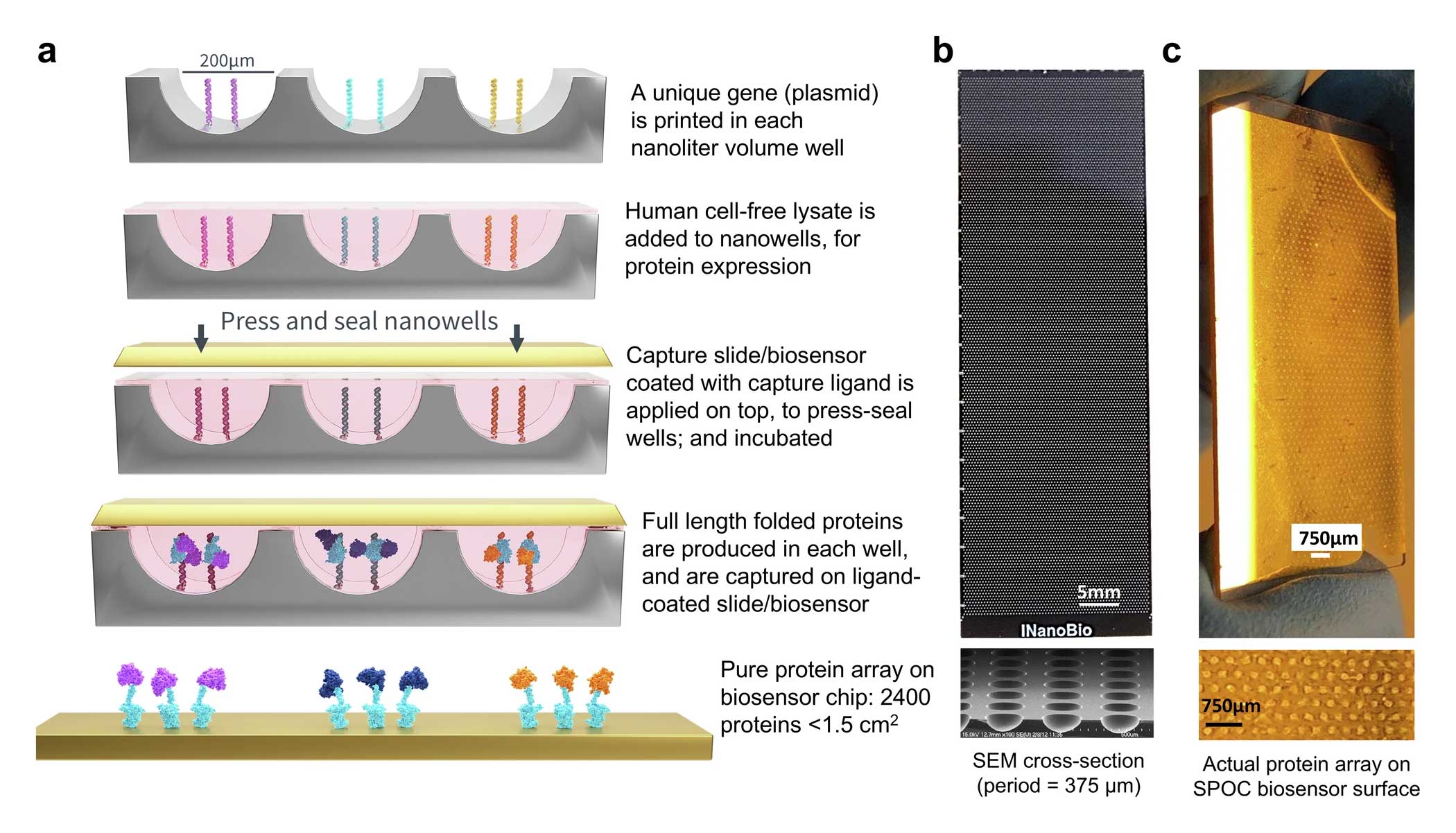
a) Plasmid DNAs encoding HaloTag-fusion proteins are printed into a silicon nanowell slide. Human IVTT lysate fills the wells, expressing full-length folded proteins that are simultaneously capture-purified onto a biosensor chip as arrayed spots for label-free SPR analysis. The AutoCap instrument runs four channels in parallel, producing up to four SPOC biosensors per nanowell slide and 16 SPOC chips per run. b) A 10 k nanowell slide (25 mm × 75 mm) with SEM cross-section shown below. Captured arrays can be analyzed on glass slides (fluorescence) or gold-coated SPOC biosensors (SPR). c) A SPOC biosensor showing the protein microarray pattern after on-chip expression and capture.
Validation results
Antibody specificity was tested with anti-p53, anti-Jun, and anti-Src monoclonal antibodies. Each bound only its cognate spot on the array. On the 30 k chip, 24 p53 replicate spots and 12 Src replicate spots clustered on the iso-affinity plot, with no cross-reactivity at neighboring positions.
To check whether the kinetics depended on how much protein was loaded onto each spot, p53 was captured at four DNA-printing concentrations (30, 50, 70, and 100 ng/µL). Rmax values scaled with concentration, ranging from 56.7 to 239.3 RU. KD’ for the anti-p53 mAb stayed within 17 to 23 pM across all four densities.
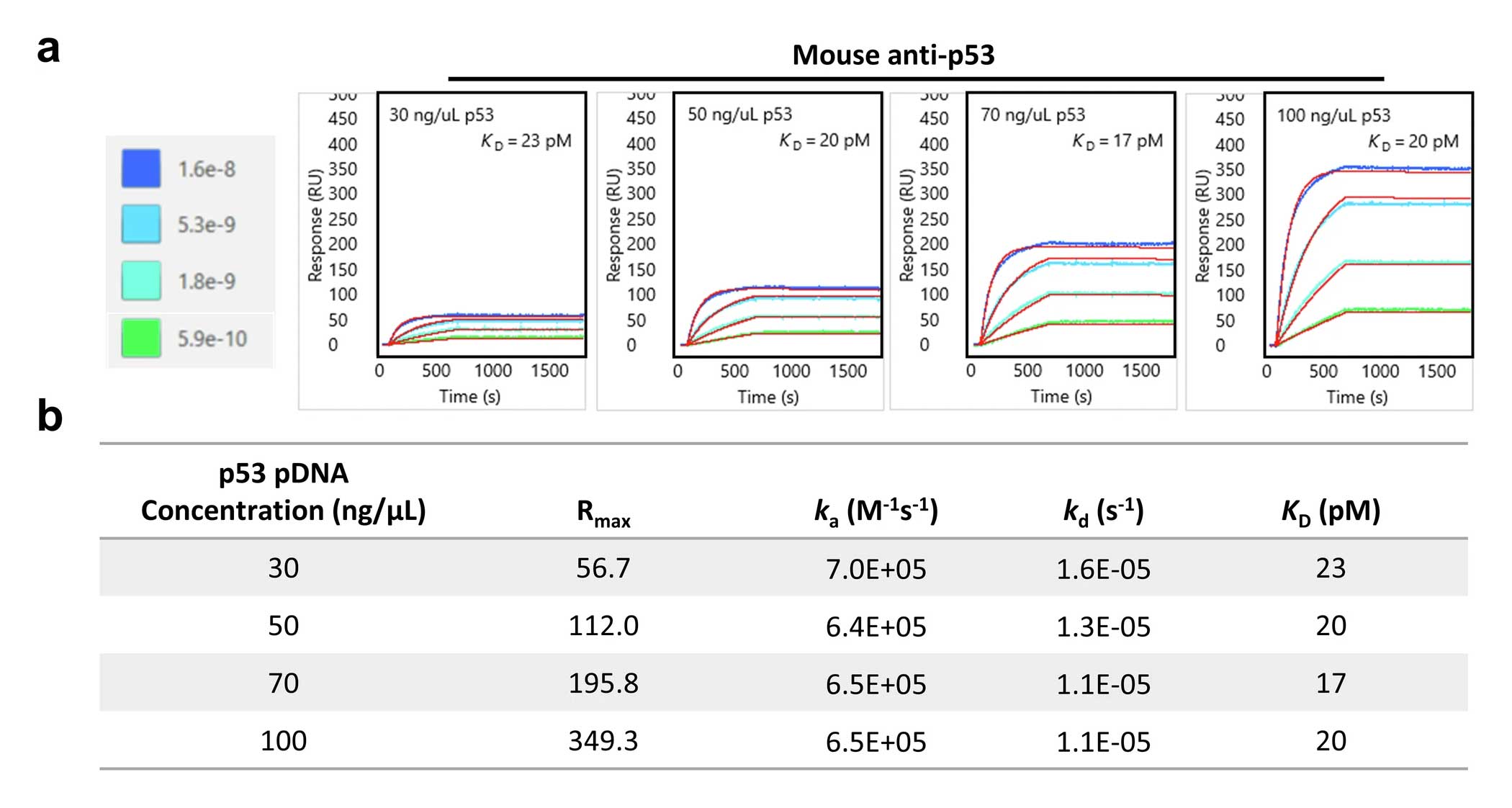
a) Anti-p53 antibody titration sensorgrams at four p53 capture levels (30, 50, 70, 100 ng/µL plasmid DNA). 1:1 model fits in red. b) Kinetic parameters per spot.
The same chip resolved the difference between bivalent and monovalent analyte binding. The anti-HaloTag IgG, being bivalent, deviated from a 1:1 binding model and returned an apparent KD’ of 3.23 nM. The monovalent anti-HaloTag VHH fit the 1:1 model with a KD of 0.77 nM, within 3-fold of the manufacturer-reported value of 2.0 nM.
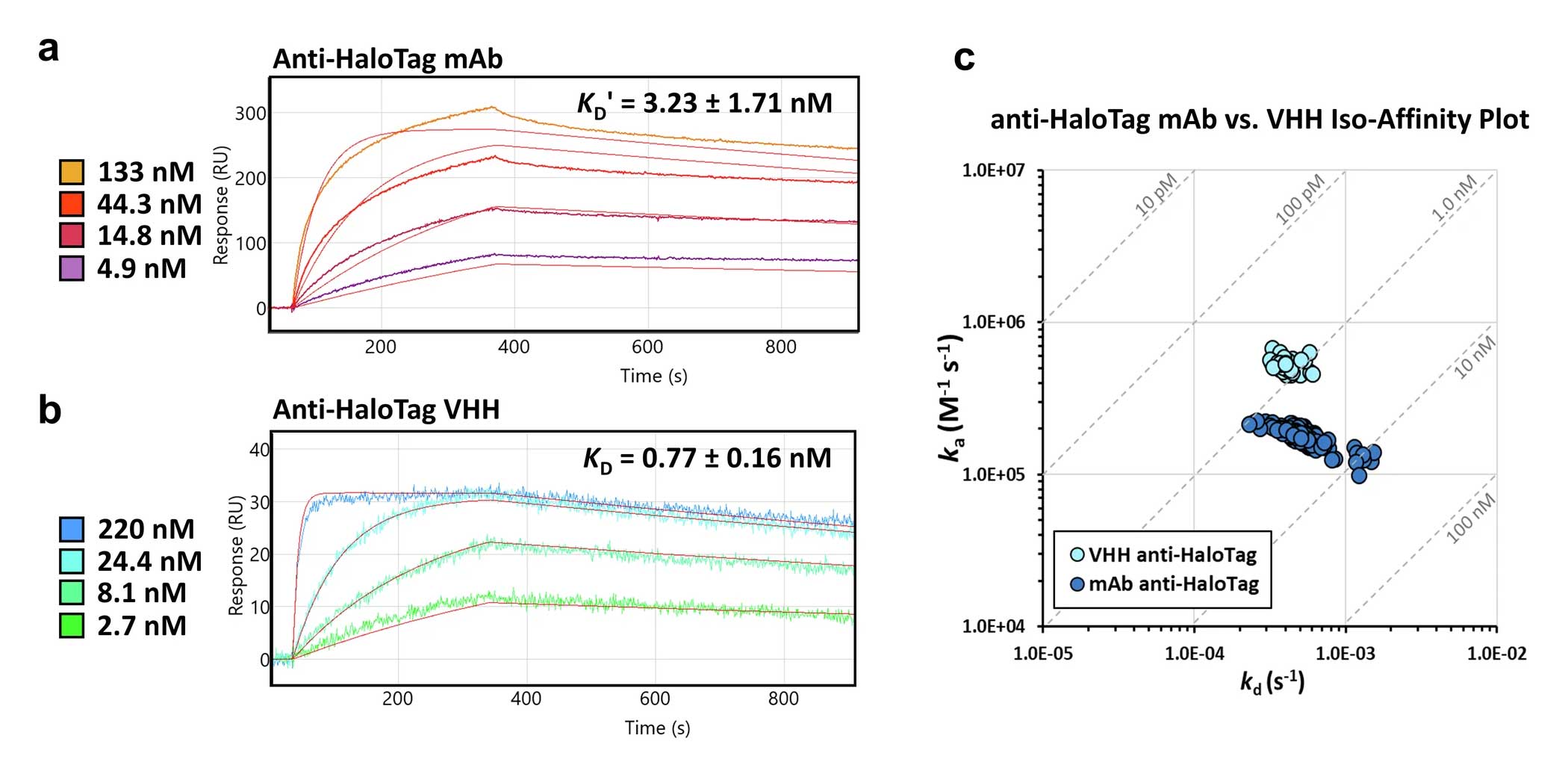
a & b) Titration sensorgrams of anti-HaloTag mAb. a) and VHH b) on the SPOC biosensor. 1:1 model fits in red. c) Iso-affinity plots for the mAb (204 spots) and VHH (49 spots).
Beyond binding, the platform captures protein function. On glass-slide arrays, anti-p53 signals showed <2% crosstalk with neighboring spots. Src autophosphorylation and dephosphorylation cycles were resolved by anti-phosphotyrosine staining. PAD2-catalyzed citrullination of HIST1H3A and FGA was detected on-chip. Fos in solution bound to Jun protein spots on the array. Arrays remained functional after 10 days of storage.
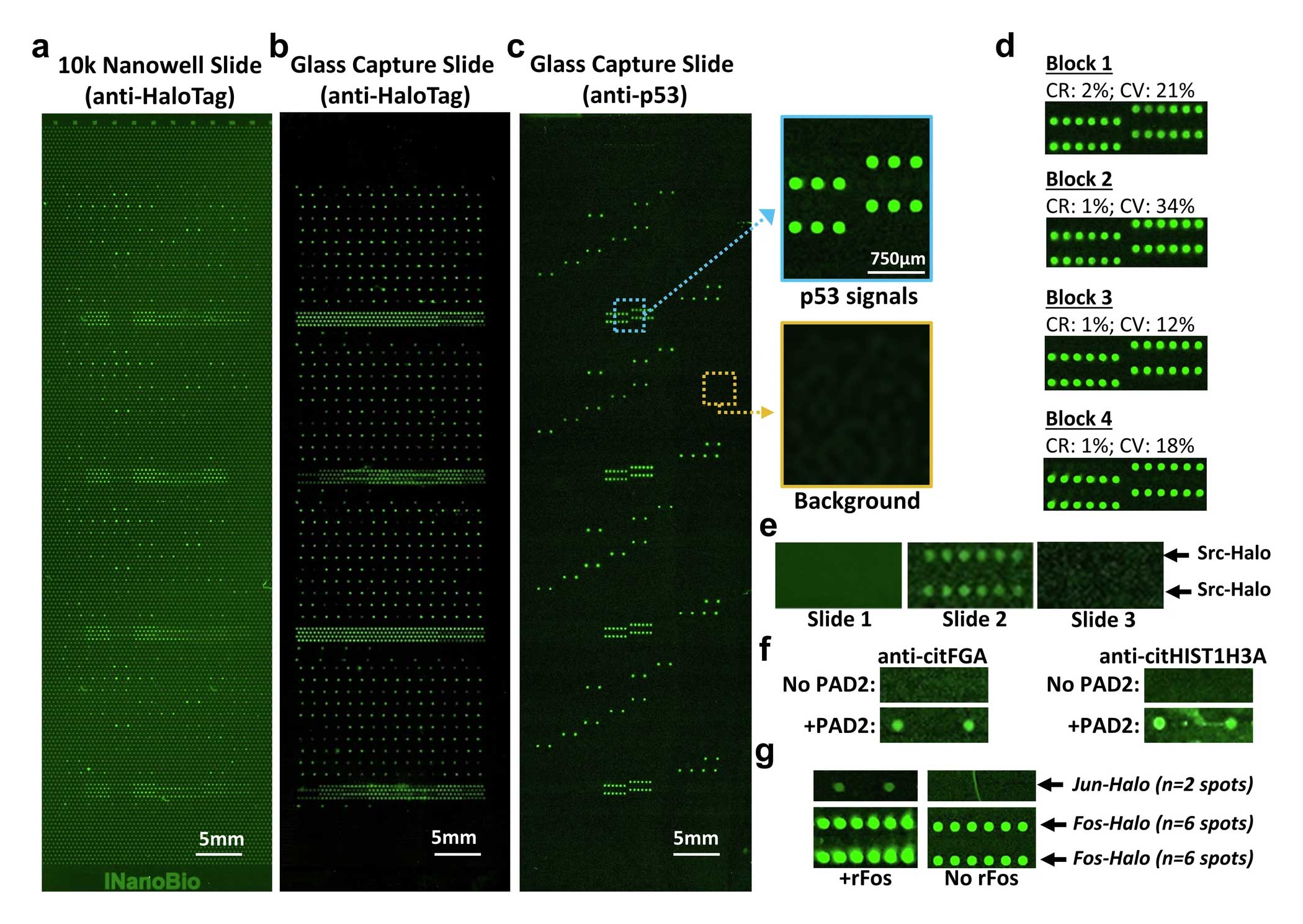
a) Anti-Halo fluorescence of HaloTag proteins expressed in silicon nanowells. b) The same proteins captured onto HaloTag chloro-alkane-modified glass slides, probed with anti-Halo. c) Same slide layout as (b), probed with anti-p53. Crosstalk between neighboring spots was <2%. d) Cross-reactivity (CR) and variation (CV) of p53 signals across sparse and dense array areas; enlarged images show the dense regions only. e) Src kinase activity on glass arrays (n = 12 spots), stained with anti-phosphotyrosine. Slide 1: dephosphorylated with alkaline phosphatase. Slide 2: dephosphorylated, then autophosphorylated in kinase buffer. Slide 3: same as Slide 2, then dephosphorylated again. f) Halo-FGA and Halo-HIST1H3A spots treated with or without PAD2 enzyme, probed with anti-cit-FGA and anti-cit-HIST1H3A. g & h) Halo-Fos and Halo-Jun spots incubated with (g) or without (h) recombinant Fos, then probed with anti-Fos. Fos appeared on Halo-Jun spots only when rFos was added; Halo-Fos spots served as positive control.
SARS-CoV-2 RBD variants
Ten SARS-CoV-2 RBD variants were arrayed on a single chip (Wuhan, Alpha, Delta, BA.1, BA.5, BA.2.75, BQ.1, XBB.1.16, XBB.1.5, BQ.1.1) and screened against two manufacturer lots of a commercial anti-RBD antibody.
The end-point fluorescence assay flagged Wuhan, Alpha, and Delta as strong binders, picked up weak binding to BA.1, and returned no signal for the other six variants. SPR on the SPOC chip resolved binding to all ten and ranked them by KD’. With Lot 2 of the antibody, Wuhan, Alpha, and Delta clustered between 14 and 26 nM. The Omicron sublineages BA.1, BA.5, BA.2.75, BQ.1, and XBB.1.16 sat between 54 and 82 nM. BQ.1.1 came in at 120 nM. XBB.1.5 returned signal too low to fit.
Lot 2 affinities ran roughly 5x stronger than Lot 1 across the same panel.
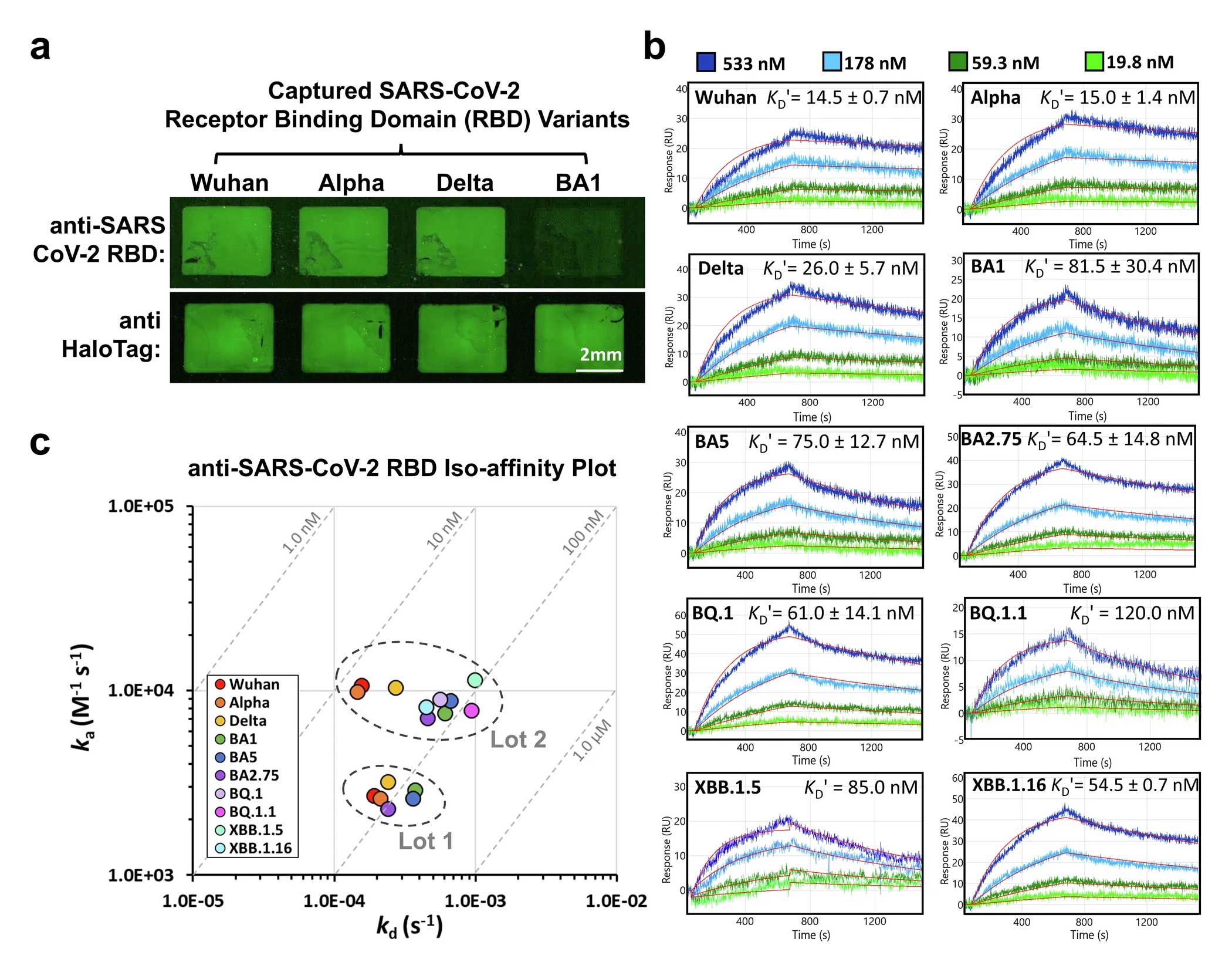
a) Fluorescent glass-slide assay of manually spotted SARS-CoV-2 RBD-HaloTag proteins, probed with mouse anti-RBD and anti-HaloTag antibodies. b) Sensorgrams from a titration of mouse anti-RBD antibody (Lot 2) over a SPOC array of 10 RBD variants on the Carterra LSAXT, with 1:1 model fits in red. c) Iso-affinity plot for both antibody lots. Lot 1 was screened on one sensor with 6 RBD variants; Lot 2 across two sensors containing all 10.
Read the paper (open access): https://www.nature.com/articles/s42003-025-07844-z
